
Introduction to Emissions Reporting
Emissions reporting is the process of measuring, analysing, and disclosing greenhouse gas (GHG) emissions associated with an organisation’s activities. This process provides a transparent and evidence‑based way to understand the climate impact of an organisation, identify reduction opportunities, and support long‑term climate action planning.
As a public sector body, Tunbridge Wells Borough Council prioritises transparent, comprehensive and robust emissions reporting, by verifying our emissions against the ISO 14064-1 Greenhouse Gases standard.
TWBC’s Emissions Reporting Approach
Verifying to the ISO 14064‑1 standard provides a robust, internationally recognised methodology and framework for calculating emissions. With its increased transparency and external verification, this approach provides confidence to stakeholders that TWBCs net zero goals are being pursued responsibly and effectively. Verification strengthens confidence in the baseline against which future reductions will be measured and ensures alignment with national and international climate frameworks.
Independent verification strengthens data governance, accuracy, transparency and ensures the credibility of the council’s emerging Net Zero Pathway.
TWBC’s Base Year
In January 2026, TWBC successfully achieved ISO 14064‑1 verification for the 2024/25 Greenhouse Gas Emissions Report, following a comprehensive series of assessments undertaken by the British Standards Institution (BSI). The audit confirmed that the report was materially accurate to a 95% assurance level.
This report forms an updated base year, from which all future reductions will be fully measured against. The reason for this updated base year is that 2024/25 represents the first year in will we have a full and accurate data for our entire emissions portfolio.
TWBC’s verified base year emissions for 2024/25 totalled 8,215.7 tonnes of Carbon Dioxide Equivalent (tCO₂e).
This is equivalent to 2% of the Borough’s total emissions.
Understanding Scope 1, 2, and 3 Emissions
- Scope 1: Direct emissions from sources owned or controlled by TWBC, including fuel combustion in boilers, council‑owned vehicles, and other stationary combustion fuels.
- Scope 2: Indirect emissions from purchased electricity used in council buildings and operations.
- Scope 3: All other indirect emissions associated with council activities, such as procurement, waste disposal, business travel, commuting, homeworking, leased assets, and other value‑chain / supply chain emissions.
The new emissions reporting methodology expands the scope of our indirect emissions, to provide a more comprehensive and representative calculation of scope 3 emissions. Additional emissions sources, that were not reported previously include:
- Homeworking
- Supply chain
- Waste
- Up and downstream leased assets
- Homeworking
- Temporary accommodation
Scope 1 and 2 Emissions Over Time
Our methodology for scope 1 and 2 has not changed, allowing us to compare how these emissions have changed over time: Please see the below charts comparing Scope 1 and Scope 2 emissions from 2018/19 to 2024/25.
TWBC has continued to reduce emissions through building efficiency improvements, decarbonisation of the national grid, and changes in energy use across its estate.
Scope 1 Emissions Over Time
Scope 2 Emissions Over Time
Scope 3 Emissions Breakdown
As historical comparisons are not available for many of our new scope 3 categories, we cannot compare total scope 3 emissions with data from previous years. The below chart illustrates the contribution of all scope 3 sources from our 2024/25 emissions report.
Latest Emissions Reports
2024/25 Base Year
Archive Reports: Previous Methodology
2023/24

2022/23

2021/22

2020/21

2019/20

2018/19

What do we mean by our own operations?




Some amazing examples of putting this into practice:
90 solar panels have been installed onto the Amelia Scott, helping to reduce grid electricity consumption, in favour of homegrown renewable energy. LED lighting has also been installed throughout the building to further reduce energy consumption through the site.
Buried beneath the Amelia Scott is a rainwater harvesting tank, holding 15,000 litres of water (that’s enough for 200 baths!) this is used to reduce mains water consumption. A net gain in biodiversity is also achieved through the inclusion of bird and bat boxes and an even an insect hotel.
Solar panels and an air source heat pump have been installed at the North Farm Depot, reducing reliance on gas for heating and grid electricity. Emissions from the depot have reduced by 47% since 2022/23 (35 tCO2e).
The Weald Leisure centre has seen suite of decarbonisations measure installed, including an air source heat pump, solar pv and LED lighting. Emissions from the Weald have reduced by 41% since 2022/23 (100 tCO2e).
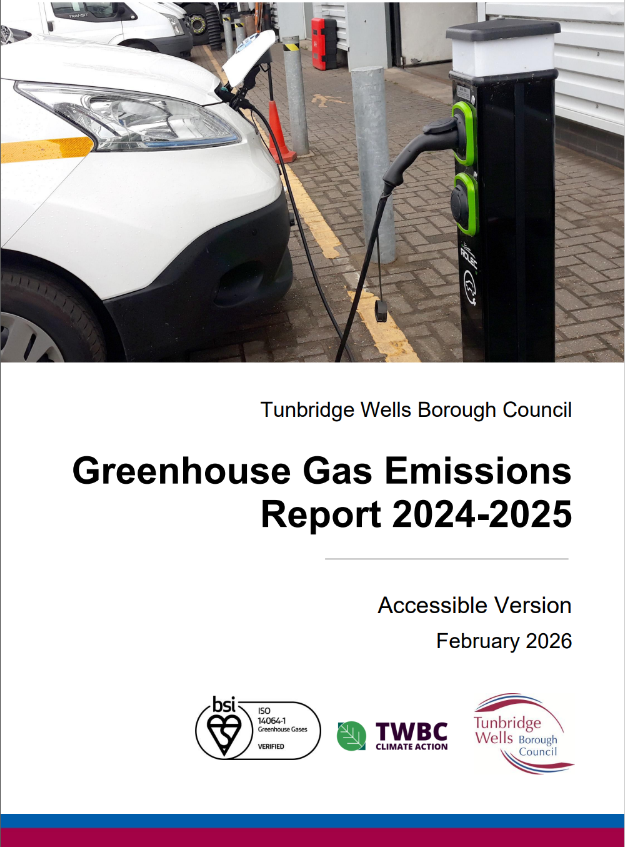
We are working to transition our fleet to electric, with 20% of our vehicle fleet already being plug-in electric and 20% plug-in hybrid. We have observed a 63% reduction in vehicle fleet emissions since 2018/19, with over 4,500 litres less diesel consumed per year!
We have decarbonised several temporary accommodation properties, by installing air source heat pumps and improving the energy efficiency of each site through upgraded fabric insulation, LED lighting, double and secondary glazing.


